CausalSplat teaches splat scenes to reason
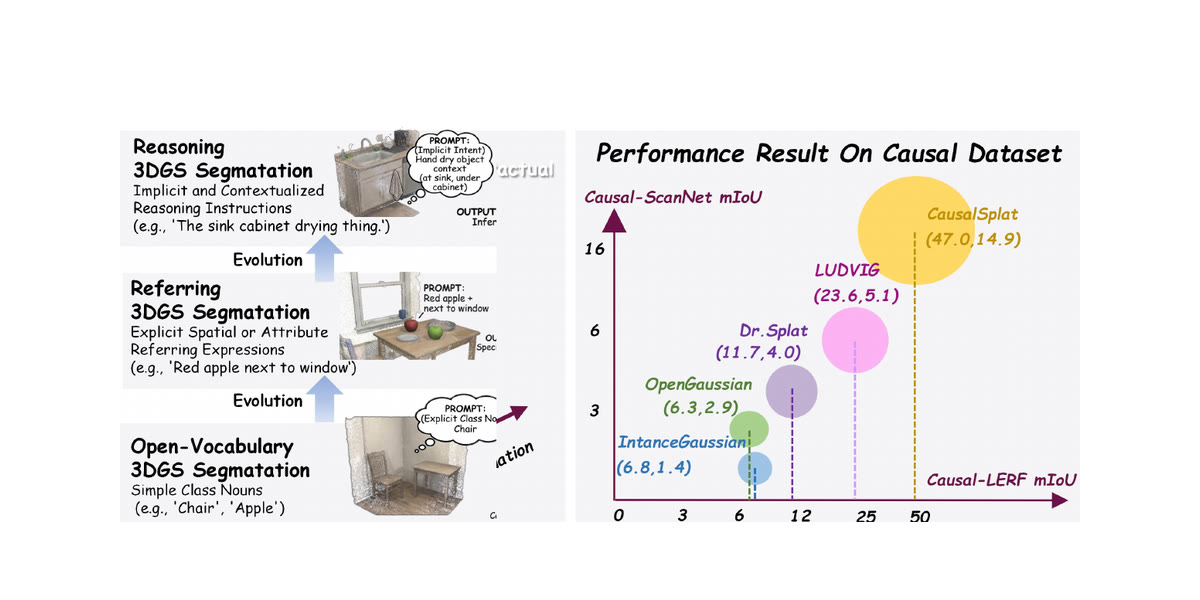
Figure: Ding et al., Peking University Shenzhen Graduate School · Research

Aug 13, 2026, 7:05 AM ETResearch
CausalSplat, a framework from Jiayu Ding and colleagues accepted to ECCV 2026, integrates vision-language models with 3D scene graphs so gaussian splatting scenes can handle implicit intents, spatial constraints and commonsense reasoning instead of only explicit queries.
Why it matters: Open-vocabulary scene understanding on splats has gotten good at explicit lookups — "find the red chair" — but embodied agents need answers to questions the scene never labels: where something would go, what an object affords, what changes if it moves.
That gap is exactly what stands between photorealistic splat reconstructions and robots that can actually act inside them.
Zoom in: The framework's core move is disentangling explicit structural perception from implicit logical inference: a 3D scene graph carries the scene's structure, while a vision-language model handles the reasoning on top of it.
By the numbers:
- Two new evaluation datasets — Causal-LERF and Causal-ScanNet — systematically test commonsense, spatial, affordance and counterfactual reasoning.
- Current state-of-the-art methods perform poorly across those reasoning challenges, the authors report.
- CausalSplat sets a new state of the art on the reasoning benchmarks while staying competitive on standard referring and open-vocabulary 3D segmentation.
What's next: The paper, submitted August 11, heads to ECCV 2026 — and the two benchmarks give a subfield that has mostly graded itself on segmentation masks a scoreboard for actual reasoning.
Go deeper: