Radiance fields stop being pictures and start being places
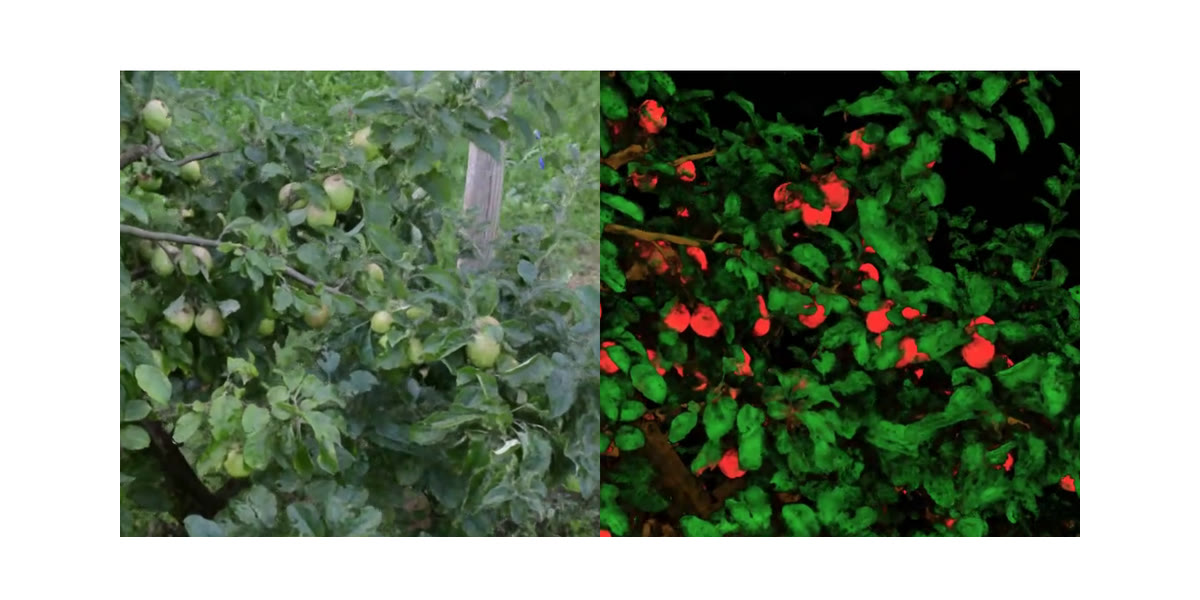
Figure: Heider et al. · Research

Aug 15, 2026, 7:00 AM ETResearch
Nico Heider, Michał Jan Włodarczyk and colleagues argue that Semantic Radiance Fields — captures that carry per-class meaning alongside colour and geometry — can serve as simulators for training embodied agents, closing the gap between synthetic worlds and real ones.
Why it matters: Simulators for robots come in two flavours, and both are compromised. Synthetic environments know exactly what every object is, because someone authored them, but they don't look like the world. Reconstructions of real places look right and know nothing — a splat of your kitchen has no idea which blob is a kettle.
The proposal is to make one representation do both jobs: keep the photometric fidelity of a capture, and attach to every gaussian a label saying what it is part of. A capture stops being footage and becomes a place an agent can be tested in.
How it works: Segmentations from pretrained 2D vision models are lifted into the 3D field, so geometry, appearance, and per-class identity are jointly encoded in one representation reconstructed from ordinary posed RGB captures.
Each class gets its own independent binary head rather than a single softmax across classes, so a point can belong to more than one thing at once — a design choice that keeps geometry from collapsing onto class boundaries.
Zoom in:
- The field exposes three operations an agent can call: render a posed RGB image from a camera pose, query the per-class probability at any 3D point, and query occupancy for collision detection.
- That trio covers viewpoint sampling, object localisation, collision checking, and per-pixel ground truth from a single grounded representation.
- Semantic ground truth comes free — it is baked into the capture rather than hand-labelled per scene.
- The worked example is an orchard: a robot reaching for an apple, with the radiance field supplying rendering, semantics, and occupancy to a physics engine.
Yes, but: This is a position paper with an outlined application, not a benchmarked system. The apple-reaching simulator is described as an example rather than evaluated against existing robot simulators.
The semantics are only as good as the 2D model that produced them — the field inherits whatever the segmentation backbone gets wrong, now baked into three dimensions.
The big picture: Captured media is quietly becoming infrastructure. The same orchard capture is a picture, a map, a collision mesh, and a labelled dataset, depending on which query you send it.
That is a more interesting destination for this technology than better-looking flythroughs.