They set fire to a gaussian splat of a real forest
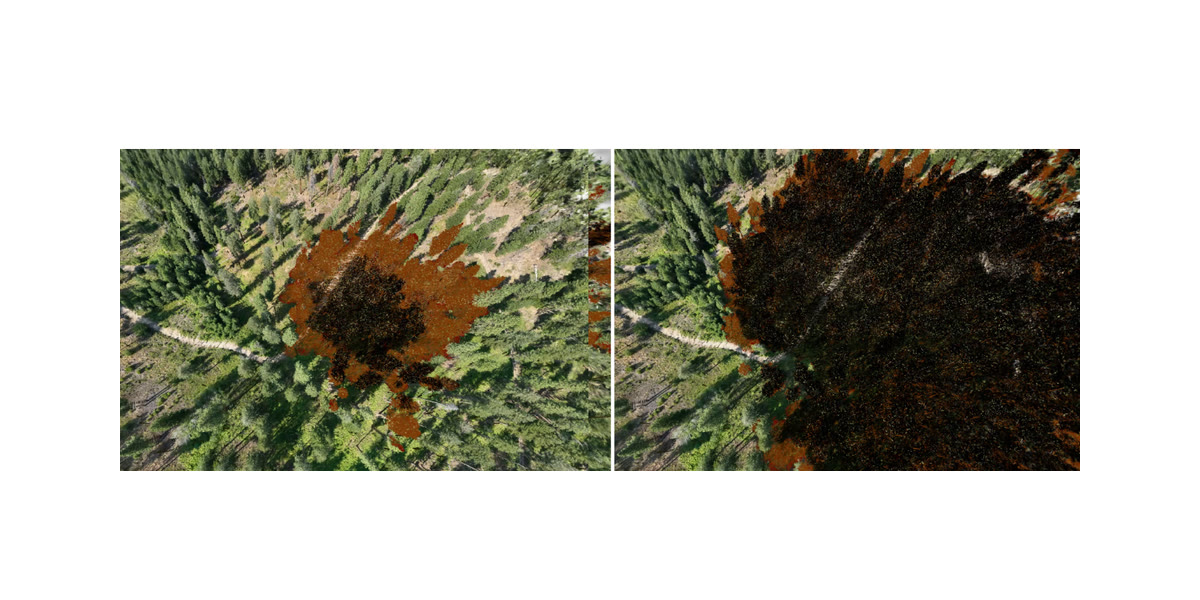
Figure: Driessen et al., TU Delft / Kiel / KAUST · Research

Aug 16, 2026, 5:45 AM ETResearch
Nienke Driessen and colleagues at TU Delft, Kiel, Adam Mickiewicz University and KAUST have built a wildfire simulator that burns gaussians — running ignition, heat transfer and flame propagation natively on a semantics-enriched splat reconstruction of a real boreal forest.
Why it matters: Physics-based wildfire models are good, and they mostly run on invented forests — synthetic environments where every tree's structure and fuel load is known because someone specified it. Real landscapes arrive as aerial imagery, incomplete and uncertain, which is exactly the case those models can't take.
This closes that gap from the other direction: keep the captured reconstruction, and teach the fire to burn it.
How it works: Gaussian primitives are augmented with semantic vegetation classes and material properties encoding fuel characteristics — so a gaussian isn't just colour and covariance, it's a piece of a particular kind of plant with a particular flammability.
A particle-based combustion model then operates natively on that representation. Nothing is converted to a mesh or a volumetric grid first, which is the part that usually destroys the detail a capture was worth having.
Zoom in:
- The test scene is a real boreal forest reconstructed from drone imagery captured by the Open Forest Observatory.
- Glowing orange gaussians are the active fire front; black ones are fully burnt and retain no burnable mass; everything else keeps its original appearance.
- Propagation scales the way it should with vegetation density, wind velocity and terrain slope — the check that the physics isn't decorative.
- A rain-driven cooling mechanism is added as an energy sink to model containment, demonstrating the framework is modular.
- Validation includes firebreak experiments and biomass loss estimation.
The big picture: Captures are turning into simulation substrates. A radiance field that was a training environment for robots one week is a fuel model the next, and neither use has much to do with looking at it.
The through-line is that captures are becoming simulation substrates. Once a gaussian can carry material properties, the representation stops being a rendering format and starts being a description of a place.
Yes, but: Physically consistent behaviour is not the same as calibrated prediction. The paper reports characteristic dynamics and validation experiments; it does not claim to forecast a specific fire.
The fuel properties are inferred from semantic classes assigned to a reconstruction, so the simulation inherits whatever the segmentation got wrong about the canopy.