The levels of a city-scale splat weren't talking to each other
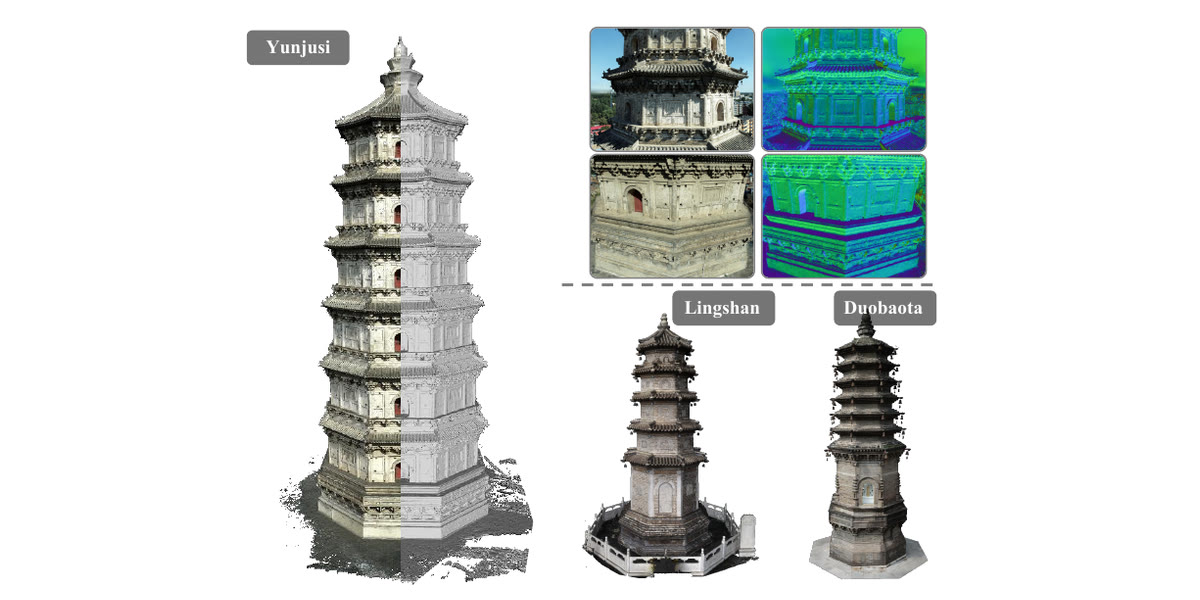
Figure: Zhang et al., Northwestern Polytechnical University (CC BY-NC-ND 4.0) · Research

Wei Zhang and colleagues at Northwestern Polytechnical University and vivo's BlueImage Lab identify a specific failure in how city-scale gaussian splats are built: each level of the octree is optimised in isolation, with no communication between them.
Why it matters: Octree-based anchor splatting is how the field currently scales to whole cities — coarse levels hold building masses, fine levels hold detail. It works, and the artefacts it produces have mostly been treated as the price of scale.
This paper argues they aren't. Colour drifting across a facade and texture smearing into mush are symptoms of one thing: levels that never exchange information.
The fix: Cross-Level Context Aggregation uses the octree's own spatial containment to group each anchor's context with its parent's and its children's, fusing the triplet through a small MLP with a residual connection. Information flows both ways: coarse structure informs fine anchors, and fine detail statistics push back up to stop the coarse level over-smoothing.
A second module enforces agreement between rendered normals and depth-derived normals, leaning on the strong planar priors that urban geometry hands you for free, to suppress floating artefacts.
The pagodas: The more durable contribution may be the benchmark. China-Pagoda is eight ancient Chinese pagodas, each captured with more than 1,200 images — dense ornamental carving, curved multi-layer eaves, and repetitive fine-grained texture.
That combination is close to a worst case for hierarchical methods: repetitive detail is exactly what a coarse level wants to average away, and curved eaves defeat the planar assumptions that make urban scenes tractable. Existing city-scale benchmarks — Mill19, UrbanScene3D, MatrixCity — are mostly flat-faced modern buildings and don't stress this.
Zoom in:
- The cross-level aggregation is claimed at negligible computational overhead — it reuses structure the octree already has.
- Edge-aware smoothness losses use a progressive warmup rather than being applied from the start.
- Evaluated on Mill19, UrbanScene3D, MatrixCity and the new China-Pagoda set.
- Code is at github.com/WZ-CS/HiCo-GS; the paper is going to ACM Multimedia 2026 in Rio.
The big picture: Heritage architecture keeps turning out to be the hard case that moves capture forward — it has the detail density that modern construction doesn't, and it is the thing people most want recorded before it degrades.
A dataset of eight pagodas is a small artefact. But benchmarks decide what a field optimises for, and this one asks for something the current ones don't.