A ray tracer just outran gaussian splatting by 2.8×
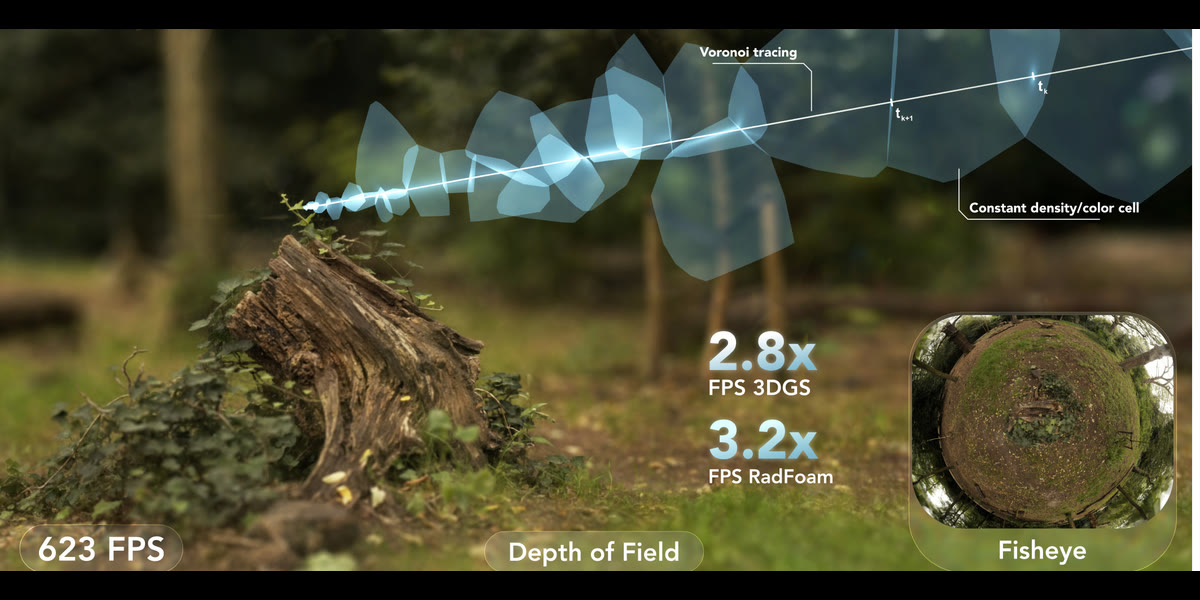
Figure: Taveira et al., Chalmers University of Technology / Zenseact (CC BY 4.0) · Research

Bernardo Taveira and colleagues at Chalmers University of Technology and Zenseact have built VoroTracing, a differentiable renderer that traces camera rays cell by cell through a Voronoi tessellation and reaches 623 frames per second on Mip-NeRF 360 — 2.8× the throughput of 3D Gaussian Splatting and 3.2× that of the fastest previous ray-based method.
Why it matters: Rasterisation is fast because it assumes a pinhole camera. Anything that breaks that assumption — barrel distortion, a rolling shutter, motion blur, a shallow depth of field — has to be bolted on as a special case, and each one is its own engineering project.
Ray-based rendering gets all of them for free, because they are just different ways of generating and sampling rays. The catch has always been that it was too slow to compete. This paper is an argument that the slowness was an implementation detail.
Where the speed came from: The most useful table in the paper is the ablation, because it holds the scene representation completely fixed and changes only the renderer. The base implementation runs at 230 FPS. Reordering cells along a Morton curve takes it to 378. Warp-coherent tiling takes it to 536. Skipping cells that contribute less than a thousandth takes it to 623.
That is a 2.7× speedup with no measurable change in PSNR or LPIPS. None of it is a new primitive or a better loss — it is traversal length, per-cell work and memory locality, which the authors identify up front as the three things that actually govern throughput.
By the numbers:
- 623 FPS on average across Mip-NeRF 360, against 194 for Radiant Foam and 131 for the ray-traced PowerFoam — while beating both on PSNR, SSIM and LPIPS.
- A fixed budget of 2M Voronoi sites, optimised without any pruning or densification.
- Per-cell spherical harmonics are replaced by compact octahedral appearance textures, cutting the memory traffic that dominates traversal.
- Best indoor PSNR of any method in the comparison, where dense initialisation and the texture representation help most.
- Source code released; Zip-NeRF sits at 0.23 FPS for scale.
Yes, but: The fixed cell budget is a real constraint. With no densification, the model cannot move capacity into regions that reconstruct badly, and final quality leans heavily on how good the initialisation was. Outdoors, where foliage and distant texture need capacity concentrated in awkward places, 3DGS still holds a 0.71 dB PSNR lead and renders the Garden scene visibly sharper.
The authors are careful about the claim, and it is worth repeating in their terms: they are not arguing that ray tracing is universally faster than rasterisation, only that a ray-based representation can beat the rasterisers most people actually use on this benchmark.
The big picture: Zenseact is an autonomous-driving company, and that explains the priorities. Sensor simulation lives or dies on the effects rasterisers treat as extensions — a rolling shutter smearing a lamppost, a fisheye covering the near field, motion blur at speed. Getting them from ray generation instead of a bespoke shader is worth a lot more there than another decibel.
The wider point is that the rasterisation-versus-ray-tracing gap has been quoted for years as a property of the two approaches. On this benchmark it turned out to be about three quarters implementation.