Their filter gained 12 dB and the pictures look the same
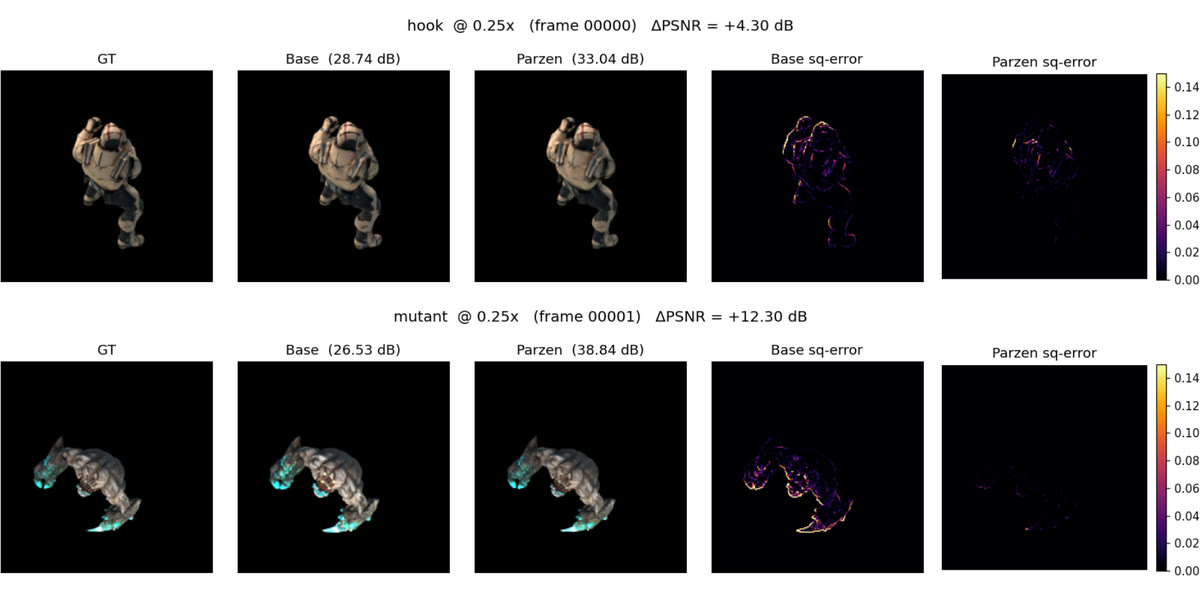
Figure: Dhiman et al., IISc Bangalore / Samsung R&D India (CC BY 4.0) · Research

Ankit Dhiman and colleagues at the Indian Institute of Science and Samsung R&D Bangalore have built an anti-aliasing filter for 4D Gaussian representations that adapts its strength to how fast each part of the scene is moving — and then spent a page of appendix establishing that its headline decibel numbers come almost entirely from a thin ring of pixels around object silhouettes.
Why it matters: A 4D splat is trained at one resolution and then, in any real application, viewed at others. Zoom in and each Gaussian is sampled more finely than it was fitted for; zoom out and it is sampled more coarsely. Both directions alias.
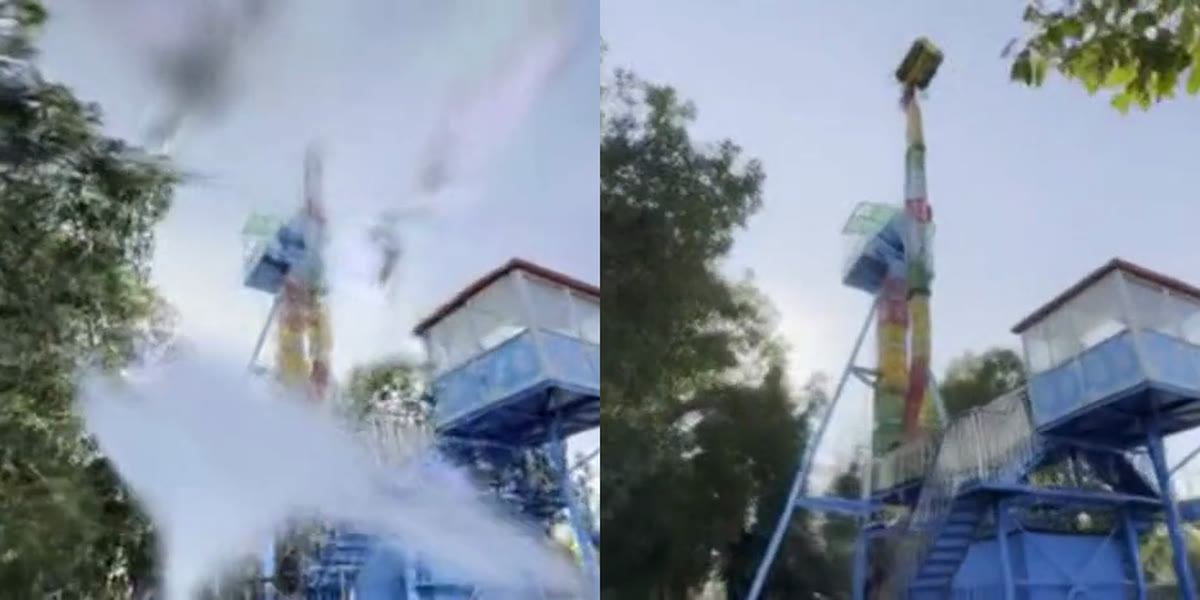
Mip-Splatting solved this for static scenes by band-limiting each primitive to satisfy the Nyquist criterion at its expected sampling rate. The trouble is that the expected sampling rate of a Gaussian that is moving is not a constant, and a filter derived from a static assumption gets it wrong exactly where the scene is interesting. Dropping Mip-Splatting into a 4D representation does not fix the aliasing; the paper's second figure shows it producing artefacts of its own around a moving human subject.
What they built: For every Gaussian, the method accumulates pairs of the focal-length-to-depth ratio and the timestamp across all training views, then fits a joint density over the two using Parzen window kernel density estimation. At render time it samples the most probable sampling rate for the current timestamp and sets the filter from that.
Estimating the sampling interval directly at each timestamp was tried and abandoned — it is too noisy, because a primitive's depth can jump between adjacent frames. Learning the joint distribution smooths that out without flattening it into a single scene-wide constant.
The design is deliberately parasitic on the underlying representation: it replaces a constant sampling rate with a time-varying one and otherwise leaves the 4D model alone. The authors demonstrate this by bolting it onto SpeeDe3DGS, an architecture unrelated to the SARO-GS they built on, and getting 4.45 dB at 4× rendering for about two extra minutes of training and fewer primitives than the baseline used.
By the numbers:
- Averaged over 1×, 2× and 4× on the Plenoptic Video dataset: 31.01 dB against 29.85 for SARO-GS and 30.33 for 4DRotorGS. The margin widens with the zoom — at 4× it is 29.79 against 27.40.
- On the D-NeRF synthetic scenes the multi-scale average is 34.50 dB against 32.97 for the best baseline, and at 4× it is 32.36 against 28.54.
- Grid4D loses 10.24 dB going from 1× to 4×. That collapse, not the headline average, is the problem being solved.
- Zooming out is worse than zooming in: SpeeDe3DGS falls from 35.01 dB at native resolution to 28.10 dB at quarter resolution, while the filtered version holds at 35.87.
- On the mutant scene, quarter-resolution PSNR goes from 27.31 to 39.20 dB.
- Cost: about 17.7 MB of extra memory, scaling as the primitive count times the size of the density grid.
Yes, but: The authors are unusually direct about what the decibels mean. At quarter resolution, base and filtered renders differ by roughly 0.9% in mean absolute pixel value, and 3.5% of pixels account for 90% of the baseline's error. Partitioned by distance from the object silhouette, the boundary band — about 7% of pixels — accounts for roughly 70% of the total error reduction, while the far background, 77% of the image, contributes 0.2%.
So the filter is doing anti-aliasing of high-frequency edges, silhouettes first and interior texture second, and PSNR is simply very sensitive to a thin ring of badly wrong pixels. The perceptual metrics move much less: SSIM 0.951 to 0.985, LPIPS 0.029 to 0.014. A +12.30 dB frame and a +4.30 dB frame look about equally fine.
There is also a real cost at the training resolution, which the paper reports without much emphasis. Tested at the same scale it was trained on, the method scores 34.82 dB on D-NeRF against 39.88 for Grid4D and 38.23 for Deformable3DGS, and 31.43 against SARO-GS's 32.09 on Plenoptic. Band-limiting a primitive to survive being zoomed costs sharpness when nobody zooms — the same trade Mip-Splatting makes, inherited intact.
The big picture: Two things are worth separating here. The engineering result is that scale-consistency in 4D needs a filter that knows about motion, and that such a filter can be attached to representations it was not designed for.
The other result is methodological, and the authors got there first about their own work: a 12 dB improvement can be almost invisible, because squared error concentrates in the few pixels where a render is catastrophically wrong rather than spreading across the many where it is slightly off. Reporting PSNR alongside SSIM and LPIPS is the paper's own recommendation, and the error maps in its appendix make the case better than the tables do.