Where the light fails, optical flow still beats the foundation models
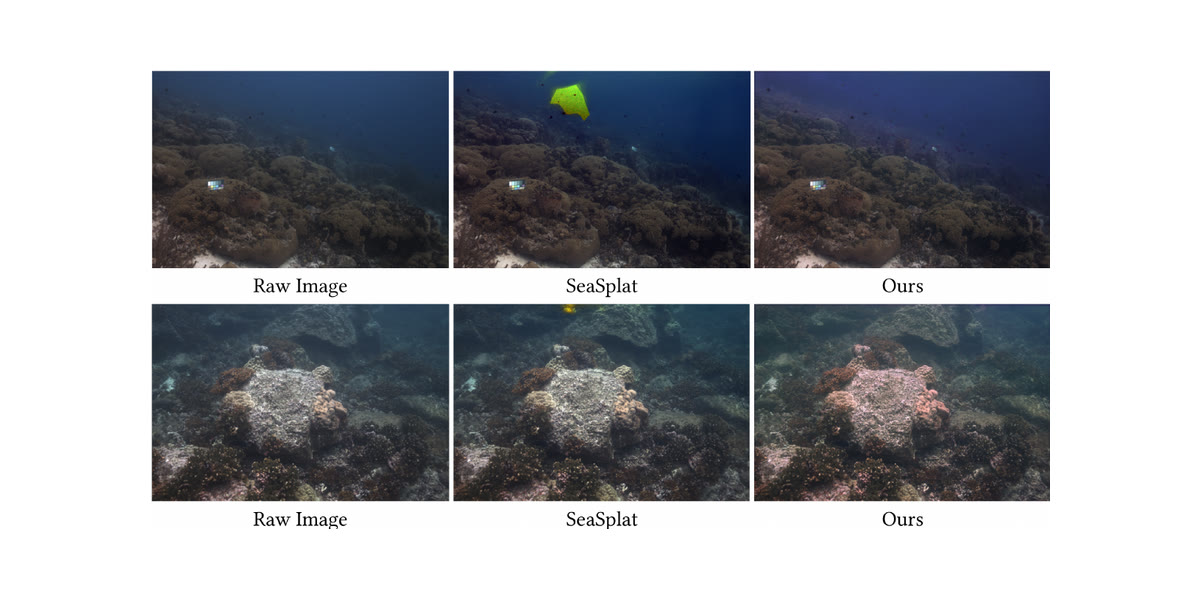
Figure: Guo et al., HKUST / Beijing Institute of Technology · Research

On Monday, a group led from Shanghai AI Laboratory posted AquaFlow, a streaming Gaussian splatting SLAM system for underwater video. The same day, a group at HKUST posted NemoSplat, a feed-forward 4D splatting model for the same setting. The two papers share a diagnosis, disagree completely about the cure, and independently arrive at the same uncomfortable result buried in their comparison tables.
Why it matters: Almost everything interesting in reconstruction over the past two years has been downstream of 3D vision foundation models — VGGT and its descendants, which estimate camera poses and dense geometry from uncalibrated images and made pose-free capture practical. They were trained on terrestrial imagery.
Water breaks the assumption underneath them. Light attenuates with distance and does so differently per wavelength, and suspended particles scatter it back into the camera. The result is that feature matching degrades exactly as range increases, and standard 3D Gaussian splatting — which assumes a clear medium — absorbs the attenuation into the colour of the primitives themselves, warping geometry to fit an optical effect.
Both papers name this. AquaFlow puts it as the clear-medium assumption breaking down; NemoSplat puts it as optical attenuation fatally corrupting feature aggregation. It is the same sentence written twice.
Two answers: AquaFlow takes the retraining route. Its authors assembled 224,273 image pairs from five public underwater datasets and fine-tuned a 3D vision foundation model on them, then built a streaming SLAM pipeline on top: medium-guided incremental Gaussian initialisation, and a hybrid representation pairing distance-conditioned neural Gaussians with an explicit physical model of underwater image formation. Training the geometry backbone took 16 RTX 4090s for 30 epochs.
NemoSplat takes the scaling route. It is a 1.22-billion-parameter feed-forward model that reconstructs directly from uncalibrated marine video in a single pass, with two purpose-built heads: a Promptable Dynamic Disentangler that isolates transient objects — fish, mostly — using learned dynamic probabilities plus optional text prompts, and a Media-Aware Gaussian Predictor that estimates water parameters jointly with Gaussian attributes. It was trained on a new dataset of 256 sequences and 155,000 frames, annotated for dynamics via a human-refined SAM3 and SAHI pipeline.
The papers do not benchmark against each other, and each declares state of the art on an evaluation set it assembled itself. This is not misconduct — they went up the same day — but it does mean the two headline claims are not commensurable, and nobody should read them as ranked.
By the numbers:
- AquaFlow evaluates on 62 trajectories: 25 from public benchmarks, 37 from in-the-wild web video. It reports 34.53 dB on FLSea Canyons against 29.33 for WaterSplat-SLAM, and 36.31 dB on UW-Stereo-VI.
- It loses on SeaThru-NeRF — 24.83 dB against the offline UW-GS at 25.79 — and says why: those scenes contain about twenty images each, and offline methods overfit small benchmarks. Naming your own losing column is not common.
- NemoSplat reports 21.58 dB, 0.68 SSIM and 0.26 LPIPS averaged over 14 real aquatic sequences, against 19.22 / 0.60 / 0.42 for AnySplat — a 2.36 dB margin and a 36.6% relative LPIPS reduction against WildGS-SLAM.
- On its synthetic set NemoSplat averages 1.88 m absolute trajectory error, ahead of VGGT at 2.12 m and StreamVGGT at 2.06 m. One competing feed-forward method, YoNoSplat, simply ran out of memory on the deep-water sequences.
- The cost of AquaFlow's quality is primitives. On Canyons it renders 610,500 Gaussians where WaterSplat-SLAM uses 13,800 — a factor of 44 — and its throughput is 1.08 frames per second. "Streaming" here means incremental and online, not real time.
Yes, but: Now the tables neither paper leads with. In AquaFlow's localisation results, DROID-SLAM — optical flow, no underwater adaptation, no foundation model — records 0.069 m of trajectory error on the S-UW scenes against AquaFlow's 0.211, and beats it again on RedSea at 0.737 against 0.958. Two of six datasets go to the method that knows nothing about water.
NemoSplat's version is starker. On the Deepsea sequences it posts 4.85 m of trajectory error; Droid-W posts 0.78 and WildGS-SLAM 0.81. That is a sixfold gap, on the hardest scenes in its own benchmark.
To their credit, the NemoSplat authors go and explain it rather than leaving it in a table. In light-deprived water, they write, the pre-trained image encoders of feed-forward architectures fail to extract reliable semantic features, while optical-flow methods can still capitalise on raw inter-frame pixel variation. They also note the inverse: on the Coral sequences, with large inter-frame motion and wide fields of view, optical flow loses its pixel associations and the learned priors win.
That is a clean statement of a real boundary. A learned encoder needs something recognisable in the frame. Optical flow needs only that the frame changed. When the water takes away the first and leaves the second, the older method is the better one.
The big picture: The field has spent two years treating pose-free foundation models as strictly dominant — a component you drop in and stop worrying about. Two independent groups, working the same week on the same medium, have now published evidence that the dominance is conditional on the scene containing enough light to have semantics in it.
For underwater work specifically that is a scheduling problem rather than a research one: shallow reef surveys and deep-water inspection are different regimes and probably want different trackers. The more general point is that the failure was legible only because both papers ran the old baselines and printed the results. Drop DROID from the comparison table, as a paper reasonably might in 2026, and the boundary disappears.